Topic: Construction
Published: 26 Oct 2026
Re-roofing a Houston house: shingles or standing-seam metal, and the parts of a roof that fail first
Choose standing-seam metal if you plan to stay 20 years or more, live where hail or coastal wind is a real risk, or can claw back an insurance discount. Choose architectural shingles if you may sell within 10 years or the budget is tight. In both cases the material is the smaller decision. Nailing, decking, flashing and underlayment decide whether a Houston roof leaks.
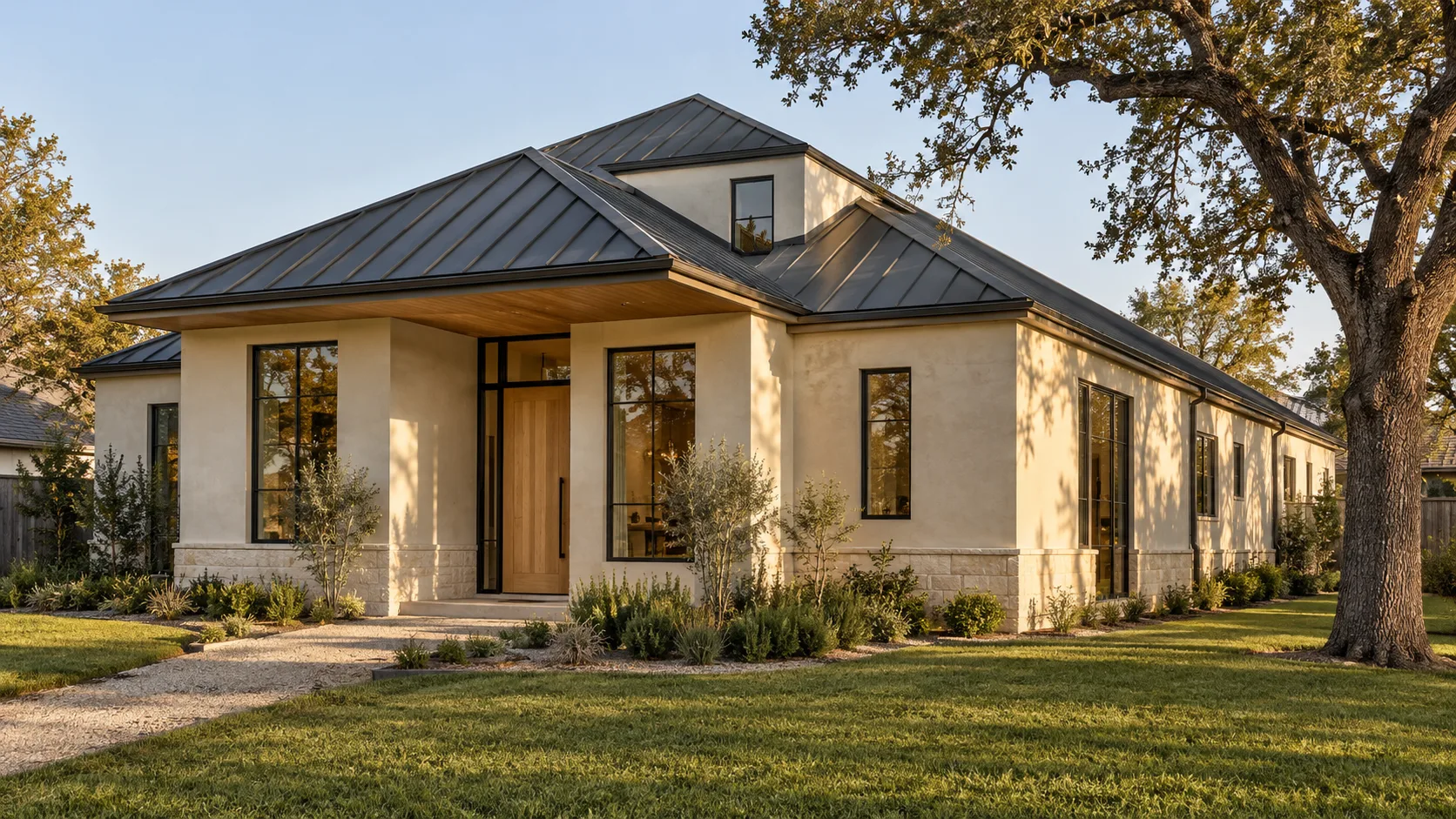
Standing-seam metal is the better roof for a Houston house you plan to keep 20 years or more, and architectural asphalt shingles are the better roof for a house you may sell in under 10. Metal costs more up front and lasts roughly twice as long in this heat. Shingles cost less and get replaced sooner. Either one fails early if the nailing, the deck, the flashing and the underlayment are done badly, and those 4 things, not the surface material, account for most of the leaks.
That is the answer. The rest of this is why, and what to put in writing before anyone climbs a ladder.
What a Houston roof actually has to survive
A roof here takes 3 kinds of punishment, and a different material handles each one differently.
Sun and heat. A roof deck in July can run well above 140 degrees, and the attic under it often does too. Asphalt shingles lose their surface granules and dry out under that for years. A shingle sold with a 30-year warranty commonly needs replacing at 15 to 20 in Houston, and the warranty usually prorates the cost long before that. Ask any roofer who has done tear-offs on Heights bungalows from the 1990s.
Wind. The coastal counties get the headlines, but inland Houston has had its own demonstrations. Hurricane Ike in 2008, Hurricane Beryl in July 2024, and the May 2024 derecho all stripped shingles and blew debris through roofs well away from the Gulf. Wind does not usually peel the middle of a roof first. It lifts the edges, the ridge and the hips, and then gets under what is left.
Hail and falling limbs. Spring storms drop hail across the metro, and a live oak limb on a ridge does more damage than most hail does. Impact resistance is rated on a 1 to 4 scale (Class 4 means the roof survived a 2-inch steel ball dropped from 20 feet under the UL 2218 test). Most shingles are not Class 4. Many metal panels are, though a Class 4 rating protects against cracking and does not stop dents, which matters if you care how it looks.
Shingles or standing-seam metal?
This is the decision shape, so here is the honest version of both sides.
Architectural shingles are 3-tab's thicker replacement, laminated in layers so they look dimensional. They are the default for a reason: any roofer in the county can install them, a crew finishes an average house in 1 to 3 days, and repairs are simple. A good installation, with correct nailing, will give you 15 to 25 years in Houston conditions. The cost is the lowest of the real options.
Standing-seam metal is the roof with raised seams running from eave to ridge and clips underneath, so no fasteners show on the surface. Panels are usually 24-gauge steel or a thicker aluminum, finished with a PVDF coating (the long-life paint used on commercial metal). The panels can expand and contract with temperature because the clips let them float. A well-installed standing-seam roof routinely lasts 40 years or more, sheds hail and wind well, and in a light color with a cool-roof finish reflects enough heat to cut attic temperatures. Expect it to cost around 2 to 3 times what architectural shingles do. That ratio moves with steel prices, so get 3 current bids and treat any number you read online, including this one, as a starting point.
The concessions on the metal side are real.
It is louder in rain on a thin deck. A solid deck, a proper underlayment and attic insulation take most of that out, but a metal roof over a vented, uninsulated attic will sound like rain. Installation takes a specialist, and Houston has fewer good standing-seam crews than shingle crews. A cheap crew that does it wrong is worse than a competent shingle crew. And if your house is in a deed-restricted neighborhood, check the restrictions first, because some require specific roof materials or colors. The article on what Houston deed restrictions control explains why that has to happen before the contract.
My pick: metal if you are staying, and shingles if you are not. A buyer will not pay you back for a premium roof you installed 3 years before you sold. The one exception is a coastal or hail-prone lot, where the insurance savings and the resistance to wind can pay for the difference sooner.
What about the exposed-fastener metal panels at the hardware-store price?
These are the corrugated or ribbed panels screwed down through the surface. They are cheaper than standing seam and they are a legitimate choice for a barn, a shed or a carport. On a house, the weak point is the screw. Each one sits in a rubber washer that cracks under Houston sun in roughly 10 to 15 years, and when it does the screw hole leaks and the screw backs out as the panel moves. The roof's surface looks fine and the deck underneath is slowly wet. If you want metal, pay for concealed fasteners.
The 4 things that fail before the material does
1. Nailing
Manufacturers specify 4 nails per shingle as the standard pattern. In high-wind zones and on steeper slopes, they require 6. Houston is not Miami, but six nails cost a few extra minutes per square and nothing in materials, and a shingle with 4 nails can lift in 80 mph gusts where one with 6 holds. Put "6 nails per shingle, at the manufacturer's nail line" in the contract.
The more common failure is high nailing. A pneumatic nail gun set too hard, or nails driven above the nail line, will miss the double thickness of the shingle and leave it hanging by a single layer. The roof looks perfect on the day of the final inspection and loses shingles in the first real storm. You cannot see this from the ground. Ask the roofer to show you the nail line on the first row, and photograph it.
2. The deck
Under the shingles is the roof deck, usually 7/16-inch OSB on newer houses and 1-by planks or plywood on older ones. Deck failures are the invisible cost of a re-roof. When the old roofing comes off, the crew finds soft, delaminated or rotted spots along the eaves, around old leaks and near the plumbing vents. The honest contract states the price for replacing deck by the sheet, so a rotten sheet has a price and nobody argues about it mid-job. A contract that says "decking as needed" with no unit price is an invitation to a dispute.
If you are re-roofing a house that had a leak, this is where the story is. Water that got in through a leaking vent boot for 6 years does not stay in one place.
Two details worth asking for, especially near the coast: ring-shank nails (8d is the common spec) to attach the deck to the rafters instead of smooth ones, and a sealed deck. That means a self-adhered membrane or taped seams over the sheathing joints, so if the roofing blows off in a storm, rain still has a second barrier to get through. It adds cost and it does what its name says.
3. Flashing and penetrations
Most roof leaks are not in the middle of a roof. They are at a valley, a chimney, a skylight, a wall where a lower roof meets an upper wall, or a pipe boot. Flashing is the metal that makes those joints watertight, and it fails because it was installed to look neat instead of to shed water.
Neoprene plumbing vent boots crack in about 8 to 12 years, long before the shingles are done. The cheap fix is a metal-flanged boot or a lead or copper-sheathed one, which costs a few dollars more per penetration. Reusing the old step flashing on a new roof is a shortcut worth refusing. It is the part that is hardest to see and cheapest to replace, and it is behind more leaks than the field shingles ever are. In valleys and around anything that penetrates the roof, ask for a self-adhered membrane under the flashing as well.
4. Underlayment and ventilation
Underlayment is the sheet between the deck and the roofing. Synthetic underlayment is now standard and holds up much better than the old felt paper, which tears and wrinkles. A roof is a system, and if the surface fails, the underlayment is what keeps the water out for the week it takes to repair.
Ventilation is the quiet one. A conventional vented attic needs air moving from soffit to ridge, or the deck cooks and shingles age faster. If you are considering a spray-foam attic at the same time, the roof is the moment to decide, because an unvented foam assembly changes the ventilation plan entirely. The article on spray-foaming an existing Houston attic covers the step that decides whether that pays. Coordinate the two jobs. Doing the roof and then cutting vents out of it later is the expensive order.
Do not roof over the old roof
You will be offered an overlay (new shingles over old) because it saves tear-off and disposal. The model residential code allows a second layer only over a single existing layer, and it hides any damaged deck you would have found. It also adds weight, holds more heat, and in Houston almost always shortens the life of the new roof. If a roofer proposes it, ask what happens to the warranty, because many manufacturers will not cover it. A tear-off is the right answer unless the budget truly forces the choice.
Permits, insurance and who you hire
Whether a re-roof needs a permit depends on the authority that governs your address, so this is a jurisdiction question before it is a roofing question: which authority permits a Houston address is not always the one the mailing address suggests. City of Houston, Bellaire, Sugar Land and unincorporated Harris County do not run identical processes, so ask your roofer which permit they pull and make sure it is in the contract. In the Texas Windstorm Insurance Association territory, which includes all of Galveston County and the coastal parts of Brazoria County, a replacement roof generally has to be built and inspected to the windstorm standard to keep that coverage. Confirm what is required with TWIA before you sign. That is a call, not a guess.
Texas does not license roofers, any more than it licenses general contractors, as the article on Texas contractor licensing explains. Vetting is your job. Ask for a certificate of insurance sent directly from the roofer's agent to you, not a photocopy from the crew. Ask whether they are certified by the shingle or panel manufacturer, because certified installers can offer a system warranty that covers workmanship, not just the product. Get the warranty terms in writing and read who pays when the roofer is out of business in year 7.
After any hail storm, canvassing crews will knock on doors offering a free inspection and a claim handled for you. State law bars a contractor from promising to cover or waive your insurance deductible, so a roofer who says "it won't cost you anything" is describing something illegal. Take their photos if you like. Call your own carrier, and hire the roofer you chose, not the one who knocked.
If your policy lists the age of the roof, ask whether a Class 4 roof earns a discount and get the answer in writing from your agent. The discount varies by carrier and changes. It is rarely enough to pay for the upgrade on its own, but it can narrow the gap.
Is a hip roof better than a gable in a hurricane?
Generally yes. A hip roof slopes on all 4 sides, so it presents less flat surface for wind to catch and lift, and it has no gable end wall to push in. If you are rebuilding or designing new, roof form is a decision that costs nothing on paper and a lot to change later. If you are re-roofing an existing gable house, the answer is to check the gable-end bracing and the overhang attachment instead of redesigning the roof.
What to put in the contract
- Tear-off to the deck, with a unit price per sheet for replacing damaged decking.
- The exact product, color and underlayment, named by the manufacturer's line.
- Nails: count per shingle and type, at the manufacturer's nail line.
- New flashing, including metal-flanged vent boots, at every penetration and wall. No reuse of old step flashing.
- Self-adhered membrane in valleys and around penetrations.
- Who pulls the permit, and a proof-of-inspection requirement before final payment.
- A written workmanship warranty with a number of years, and the manufacturer warranty registered in your name.
- Cleanup: a magnetic sweep of the lawn and driveway for nails. Texas tires and bare feet will thank you.
Most of that costs little, and the contractor who objects to it has told you something.